


A Strong Partnership: USAFE Meets Soccer Tradition
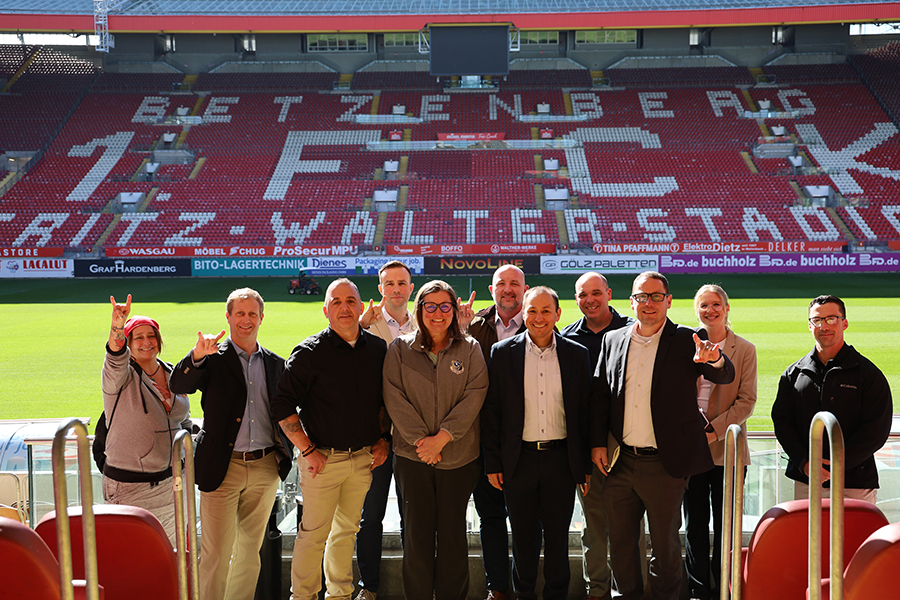
Foto: USAFE
The close friendship between the American community in Kaiserslautern and 1. FC Kaiserslautern has existed for many years—whether on a personal level through fan clubs that have even made their way to the U.S., or through joint projects such as the “9/11 Stair Climb” at the Fritz-Walter-Stadion, which commemorates the first responders who lost their lives in the terrorist attacks of September 11, 2001.
This connection has now been further strengthened through the Leadership Connect Program: The joint meeting at FCK provided an opportunity to get to know each other personally and offered fascinating insights into the world of a historic soccer club. Both during the stadium tour, which highlighted the club’s influential figures and major successes, and in discussions with the management, it became clear just how deeply the club is rooted in the city and the entire region. For many employees, FCK is far more than just an employer: they clearly approach their work with great passion.
The participants included representatives from the U.S. Air Force and Army, as well as FCK’s executive management and department heads. These included Managing Director Thomas Hengen and Sporting Director Marcel Klos. Particular emphasis was placed on the close and trusting collaboration within the leadership team. Decisions are made through ongoing dialogue in a structured, collaborative manner, often following the dual-control principle and taking into account short-, medium- and long-term goals. However, the dynamic environment of professional football requires a high degree of flexibility and the ability to react quickly to unexpected events, such as injuries shortly before the transfer deadline.
It also became clear that successful leadership relies on clear structures, effective communication and reliable planning. Trust within the inner circle is essential, particularly when dealing with sensitive matters. In an emotionally charged environment such as football, the pressure is high, not only from fans, but also from one’s own staff. This makes a functional, trusting working relationship all the more important. There is also intensive interaction with the players, including discussions about how they present themselves and the club to the outside world. Pierre Charrier, Senior Director at SPORTFIVE, provided additional insights. In his role as location and team leader, he described the collaboration with the club from the perspective of FCK’s sports rights marketer, with a particular focus on marketing and sales strategies.
Compared to the U.S. military, FCK's hierarchy is currently fairly flat. However, this could change as the club grows continuously and becomes more professional. After all, the demands on a club's structure and organization increase as it grows.
Differences between organizations are also evident in their communication methods. While some sectors tend to communicate more digitally (e.g., via email), others, such as the military, rely on direct lines of communication along clearly defined hierarchies. Regardless, there was a consensus on the importance of having clear agreements about expectations, availability, and communication channels. In this context, leadership means setting priorities and providing direction above all else.
Another fascinating topic was risk management, which is assessed differently depending on the context. In business, it often comes down to financial implications; in a military context, however, it can be a matter of life and death. This makes it all the more important to teach young people from an early age to realistically assess risks and make informed decisions.