

Visiting Jakob Becker in Mehlingen
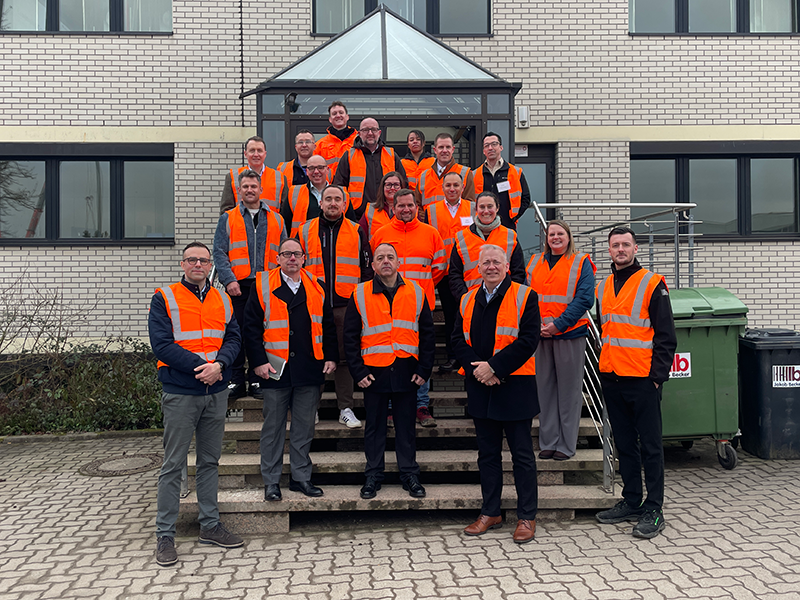
Foto: ZRW
At our Leadership Connect meeting with Air Force and Army executives at Jakob Becker Entsorgungs GmbH, the headquarters of the Jakob Becker Group in Mehlingen, we gained exciting insights into a traditional family business with a focus on the future. The meeting impressively demonstrated how different structures can be, while also highlighting the many similarities that still exist.
Since its foundation in 1898, the company has continued to grow. Today, the group comprises over 40 companies and holdings, with 69 locations in Germany and additional sites in Austria and Italy. It employs more than 2,400 people. Notably, the company is 100 percent family-owned, a fact that continues to impact the corporate culture to this day.
In addition to traditional waste disposal, Jakob Becker GmbH's range of services includes hazardous waste management, wastewater technology, drain cleaning, and container services. Sustainability is also a top priority: electric trucks are already in use, and wherever possible, energy is recovered from waste. The company also has a long-standing connection with the armed forces: Jakob Becker has been working with the US Air Force at the Ramstein Air Base for more than 40 years.
During the subsequent tour of the company's premises, the complexity and technical demands of modern waste disposal processes became clear. The discussion about the differences in waste separation between Germany and the USA was particularly interesting. While Germany has a largely uniform system, the USA leaves waste separation regulation to individual states or cities.
The structural differences between the private sector and the military were also discussed at length. While Jakob Becker has relatively flat hierarchies, the armed forces are more hierarchical in their organisation. Leadership in both areas is based on competence and performance, but in the military, rank and position also play a role. Approaches to continuing education also differ: in the armed forces, leadership programmes are clearly defined, whereas at Jakob Becker, the focus is on developing skills regardless of formal titles, based on knowledge imparted to employees from the outset.
Another area of focus was generational diversity. While large age differences in management positions can pose challenges, they also offer enormous potential. Against the backdrop of demographic change in particular, it is important to combine the experience and knowledge of older employees with the potential of younger ones. This requires a culture of acceptance and mutual respect.
Both sides face similar challenges when it comes to attracting qualified professionals. Having a strong social media presence is becoming increasingly important for reaching potential young talent. Above all else, today's young people expect stability, appreciation, opportunities for development, and a good work-life balance.
Another key topic was knowledge transfer. For example, while Jakob Becker places great importance on passing on implicit experiential knowledge before retirement, comprehensive documentation is standard practice in the military sector to continuously improve processes and minimise risks.